

The Indian River Lagoon
Overview
The Indian River Lagoon (IRL) is one of North America’s most diverse estuaries and one of the District’s highest priorities for restoration. Despite its name, the IRL is not a river, it is a shallow estuary made up of three connected lagoons: Mosquito Lagoon, Banana River, and Indian River. Together they extend 156 miles along Florida’s east coast from Volusia County to Martin County.
The Challenges
Decades of human activities have affected the health of the lagoon. Stormwater runoff, wastewater discharges, septic systems, agricultural runoff, altered drainage patterns, and the loss of natural wetlands have increased the amount of freshwater, sediments, and nutrients entering the estuary. In some areas, water remains in the lagoon for long periods of time, making it more susceptible to harmful algal blooms and poor water quality.
One of the clearest indicators of the lagoon’s health is its seagrass. Seagrass provides essential habitat for fish, shellfish, manatees, and many other species. Declines in seagrass often signal declining water quality and ecosystem stress.
Our Priorities
The District is working with local, state, and federal partners to restore the Indian River Lagoon through science-based management and long-term investment. Our priorities include:
- Monitoring water quality and seagrass to measure ecosystem health and track progress.
- Reducing nutrient and sediment pollution entering the lagoon.
- Protecting and restoring coastal wetlands that improve water quality and provide critical wildlife habitat.
- Supporting restoration projects through strong partnerships with local governments, state agencies, nonprofits, and community organizations.
A Long-Term Commitment
Restoring the Indian River Lagoon will take time. The challenges facing the lagoon developed over many decades, and meaningful improvements will occur over years of sustained restoration efforts. By combining sound science, strategic projects, and strong partnerships, the District is committed to improving water quality, restoring habitats, and ensuring a healthier lagoon for future generations.
Useful links
Seagrasses of the lagoon
An interactive StoryMap that explains the importance of seagrass in the Indian River Lagoon, highlighting its ecological role, restoration efforts, scientific monitoring, and ways the public can help support lagoon recovery.
Fast facts
A fact sheet highlighting the Indian River Lagoon’s size, ecological diversity, economic importance, and role as one of North America’s most biologically diverse estuaries.
Restoring coastal wetlands
An overview of the Flagler County Wetland Restoration Project, highlighting efforts to restore coastal wetlands, improve habitat, and recover ecological functions altered by historic mosquito-control practices.
Seagrass Extent Interactive Map
Explore spatial data showing seagrass coverage across the Indian River Lagoon.
IRL Seagrass Open Data
Access downloadable datasets, metadata, and related resources from SJRWMD’s open data portal.
Technical Materials
A resource page providing access to scientific reports, journal articles, fact sheets, and technical publications related to the ecology, water quality, seagrass, and management of the Indian River Lagoon.
Frequently Asked Questions
Are algal blooms predicatable?
The location, timing and duration of algal blooms remain difficult to predict due to complexities associated with delivery of nutrients to the lagoon, uptake and cycling of those nutrients by various organisms, and interactions among organisms and with the environment. The lagoon has had algal blooms throughout its history, but the occurrence of blooms with negative effects has been increased by people’s activities. We can predict fewer detrimental effects if we reduce the availability of nitrogen and phosphorus, two nutrients needed in large quantities. Tens of millions of dollars in projects designed to reduce the availability of these nutrients have been completed by numerous partners, and many more projects are underway or planned. Sampling has documented localized improvements, such as a decrease in the flux of nutrients from muck after dredging in Turkey Creek (source: Impacts of Environmental Muck Dredging report prepared by Florida Institute of Technology for Brevard County). However, ultimate success will require the combined effects from many projects, with full restoration predicted to take at least fifteen years and cost more than four billion dollars (source: Impediments to Implementation of the Indian River Lagoon Basin Management Action Plans prepared by the East Central Florida and Treasure Coast Regional Planning councils for the Florida Department of Economic Opportunity). In short, decades of impacts brought us to where we are, and a turnaround in the lagoon will not happen overnight.
When does an algal bloom become harmful?
Some – not all – algae can produce toxins that can contribute to environmental problems and affect public health. Little is known about exactly what environmental conditions trigger toxin production. Over time, these toxins are diluted and eventually break down and disappear. Non-toxic blooms can also harm the environment by depleting oxygen levels in the water column and reducing the amount of light that reaches submerged plants.
The Florida Department of Health (DOH) recommends staying out of the water when a visible bloom is present and recommends not swimming or fishing in areas where algae is seen. More information on Public Health effects can be found here.
Is the Florida Department of Environmental Protection (DEP) sampling the lagoon or only sampling if there is a concern for toxicity?
DEP and Florida’s water management districts frequently monitor Florida’s water quality, and routinely collect freshwater algal bloom samples as soon as they are observed as part of their routine monitoring. In addition, staff can be deployed to take additional samples in response to reported blooms – whether from a citizen, other response team agencies or other sources.
All algal samples are tested to identify the type of algae present. If the algae are a type that is capable of producing toxins, it is then tested to determine if it is producing toxin and if so, at what level. The toxins typically tested for include microcystin, cylindrospermospin and anatoxin-a.
Are septic tanks near the Indian River Lagoon to blame for algal blooms?
There is no sole source of nutrients to blame for algal blooms because all sources collectively contribute to the nutrient enrichment of the Indian River Lagoon. To achieve restoration all sources will need to be addressed.
DEP and the St. Johns River Water Management District (district) are committed to working with local communities to expedite and implement projects that improve water quality conditions and contribute to ongoing restoration of the lagoon.
Moving forward, we will continue to focus on restoration – efforts to improve water quality in the lagoon. These restoration projects are essential to reducing nitrogen and phosphorous levels, which can decrease the intensity and duration of algal bloom events.
Specifically, we will focus on identifying additional wastewater and stormwater projects to reduce the amount of nutrients going into the lagoon; dredge projects to remove muck that exists in the bottom of the lagoon, which also feeds algae blooms; and when areas of the lagoon are ready, projects to restore the oyster and seagrass habitat of the lagoon.
Recognizing that the health of the lagoon is vital to Florida’s environment, economy and quality of life, the department has identified the lagoon as a priority waterbody for restoration. To formally implement the projects and activities necessary to bring the lagoon back to health, the department adopted pollutant-reduction targets for nitrogen and phosphorus and established three restoration plans to address specific challenges in each section of the lagoon.
What role do sewage spills play in impacting water quality in the lagoon?
Sewage spills are one of many sources of nutrients that can be reduced via projects to improve systems that collect and treat wastewater. Large, intense and persistent algal blooms are unlikely to be the result of a single sewage spill, but each spill contributes to the loads available within a system.
Which sources are the biggest contributors to nutrients in the lagoon?
There is no single source that is solely responsible for an overabundance of nutrients in the Indian River Lagoon. The charts below illustrate the chief sources of nitrogen (TN) and phosphorus (TP) in pounds per year:
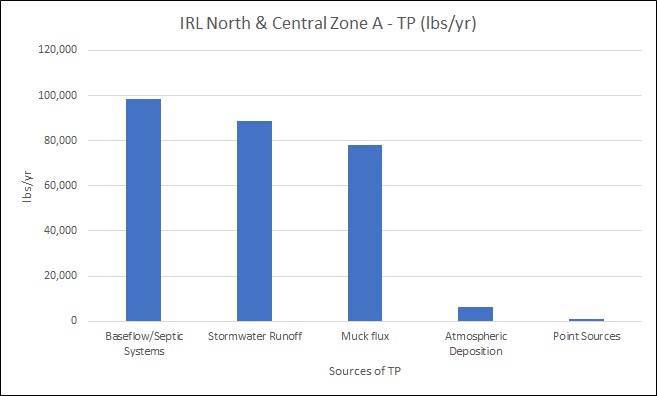
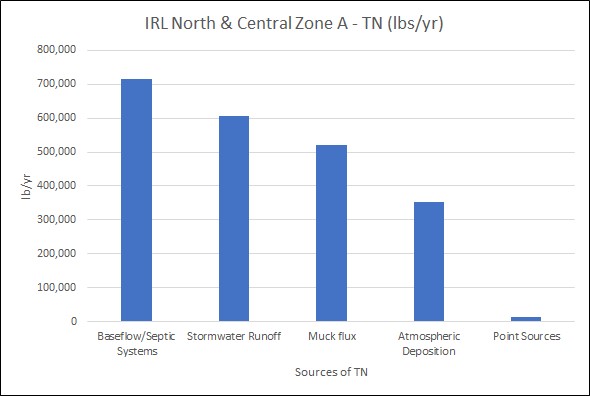
Why not simply add an additional link or inlet connecting the lagoon to the Atlantic Ocean to improve water circulation in the areas with the most frequent and intense algal blooms?
Although reducing excess nutrient, freshwater and contaminant inputs to the lagoon remains critical to its long-term health, it is prudent to assess other ways to reduce the detrimental effects of algal blooms in the short-term, such as enhanced exchange with the ocean or enhanced circulation within the lagoon. Agencies and academics (Indian River Lagoon National Estuary Program, the District, DEP, and Florida Tech) are collaborating to evaluate ideas and options, including a pilot project to document benefits and impacts from enhanced flows of oceanic water into the Lagoon and conversion of causeways to high-span bridges.
Any effort to alter exchange or circulation will be complex and costly, and each effort should be based on rigorous and careful consideration of both benefits and risks. For example, projects that increase exchange or circulation to a level that keeps pace with the initiation and spread of detrimental algal blooms may be more expensive, less effective and riskier than projects that prevent blooms in the long-term by reducing nutrient inputs. For example, blooms have been recorded near existing inlets, and evaluations of exchange through the Army Corps of Engineers’ locks at Port Canaveral indicate that the average flow through this facility is too low to reduce the residence time of water substantially.
All partners will continue to explore options, with goals being the design, siting and funding of a pilot project.
What should I do if I see an algal bloom?
Residents statewide can report algal blooms to the Florida Department of Environmental Protection (DEP) 24 hours a day, 7 days a week. Information can be reported online through a website at www.reportalgalbloom.com, as well as through a toll-free number at1-855-305-3903.
What should I do if I see a fish kill?
To report fish that are either dead or in poor physical condition, residents should contact the Florida Fish and Wildlife Conservation Commission’s (FWC) Fish Kill Hotline at 1-800- 636-0511.
What happens when an algal bloom is reported?
DEP collects detailed information such as location, description and size of the bloom. The reports are then evaluated and prioritized for inclusion in sampling plans based on severity of the bloom and potential for human exposure. The reports are also shared with appropriate collaborative agencies to ensure an effective and efficient response.
Who collects samples of freshwater algal blooms?
DEP, FWC, and Florida’s water management districts frequently monitor Florida’s water quality, and routinely collect algal bloom samples as soon as they are observed as part of this effort. In addition, staff can be deployed to take additional samples in response to reported blooms – whether from an individual, other response team agencies or other sources.