Watering Restrictions
The St. Johns River Water Management District’s watering restrictions are designed to ensure the efficient use of water for landscape irrigation. The restrictions allow enough water to maintain healthy landscapes year-round. The mandatory restrictions specify the time when watering may occur, the amount of water that may be applied, and the days when watering may occur.
The St. Johns River Water Management District’s watering restrictions are designed to ensure the efficient use of water for landscape irrigation. The restrictions allow enough water to maintain healthy landscapes year-round. The mandatory restrictions specify the time when watering may occur, the amount of water that may be applied, and the days when watering may occur for residential and nonresidential locations. These days depend on whether the address ends in an odd or even number, and on the time of year.
District Water Use Advisory | Phase III Extreme Water Shortage
A Phase III Extreme Water Shortage has been declared due to ongoing drought conditions across portions of the District. Below-average rainfall, declining groundwater levels, and reduced river flows continue to place significant stress on regional water resources.
Water shortage declarations are temporary measures used to help protect water supplies during extended dry periods. Conditions are monitored regularly, and additional restrictions may be implemented if conditions continue to worsen.
What a Phase III Extreme Water Shortage Means
Under a Phase III water shortage:
- Landscape irrigation is limited to one day a week and prohibited between the hours of 8 a.m. and 6 p.m.
- Irrigation of new plantings, including sod, is further restricted.
- Commercial, industrial, and institutional users must suspend certain non-essential water uses.
- Aesthetic water use is prohibited, and additional restrictions apply to activities such as street and pressure washing.
- Wasteful and unnecessary water use is prohibited.
- Residents, businesses, agricultural operations, and other water users are encouraged to proactively plan for continued dry conditions and the potential for additional restrictions.
Landscape Irrigation Under Phase III Extreme Water Shortage
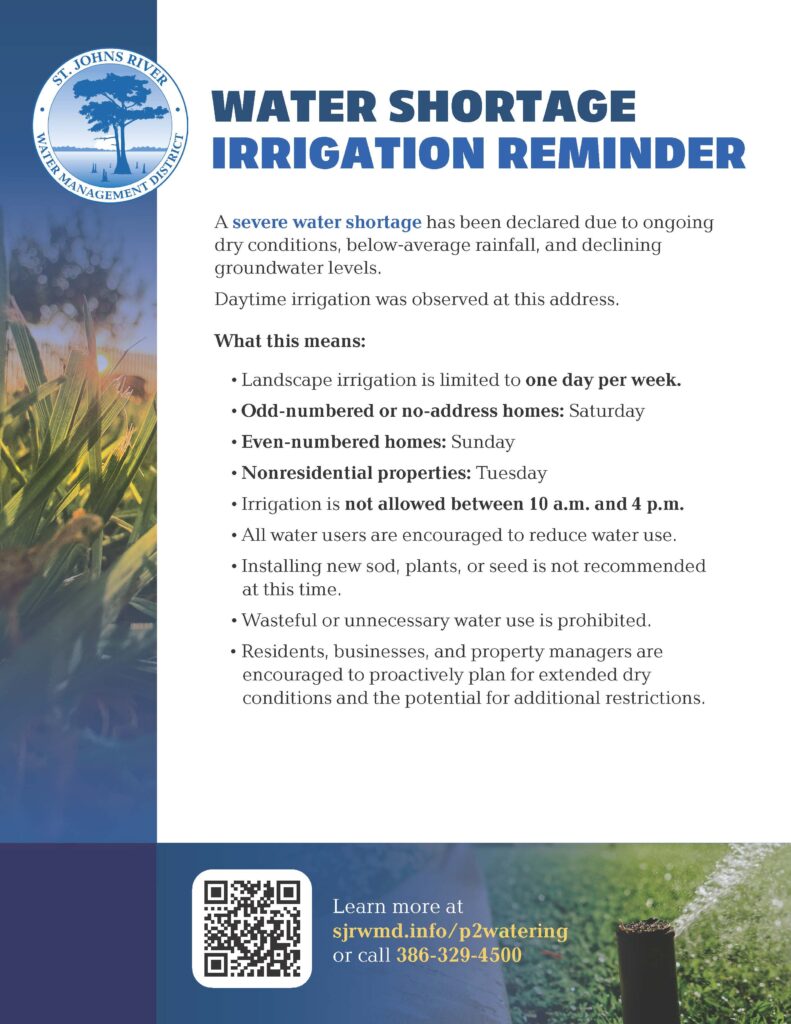
Landscape irrigation in areas subject to a Phase III Extreme Water Shortage is limited to one day per week. If you have not already reset your irrigation timer so that irrigation only occurs one day per week and only between the hours of 6 p.m. and 8 a.m., this should be done immediately. Residents are also encouraged to inspect irrigation systems for leaks and ensure sprinklers are only watering landscaped areas, not streets, sidewalks or driveways, to help prevent unnecessary water waste during ongoing drought conditions.
Currently, the watering schedule for this area is:
| Homes with odd numbered or no addresses | Homes with even numbered addresses | Nonresidential properties | |
|---|---|---|---|
| Saturday | Sunday | Tuesday | |
| |||
Landscape Irrigation for Areas Not Included in a Water Shortage
| Time of year | Homes with odd-numbered or no addresses | Homes with even-numbered addresses | Nonresidential properties |
|---|---|---|---|
| Daylight saving time | Wednesday/Saturday | Thursday/Sunday | Tuesday/Friday |
| Eastern Standard Time | Saturday | Sunday | Tuesday |
| |||
Preparing for Worsening Conditions
Dry conditions may persist, and residents and businesses are encouraged to plan ahead. Taking conservation steps now can help reduce the need for more restrictive measures.
Irrigation terms
“Landscape irrigation” means the outside watering of plants in a landscape such as shrubbery, trees, lawns, grass, ground covers, plants, vines, gardens and other such flora that are situated in such diverse locations as residential areas, public, commercial and industrial establishments, and public medians and rights-of way. “Landscape irrigation” does not include agricultural crops, nursery plants, cemeteries, golf course greens, tees, fairways, primary roughs, and vegetation associated with intensive recreational areas, such as playgrounds, football, baseball and soccer fields.
“Residential landscape irrigation” means the irrigation of landscape associated with any housing unit having sanitary and kitchen facilities designed to accommodate one or more residents, including multiple housing units and mobile homes.
“Microirrigation” means the application of small quantities of water directly on or below the soil surface or plant root zone, usually as discrete drops, tiny streams, or miniature sprays through emitters placed along the water delivery pipes (laterals). Microirrigation encompasses a number of methods or concepts, including drip, subsurface, microbubbler and micro-spray irrigation, previously known as trickle irrigation, low volume or, low-flow irrigation.
“Nonresidential landscape irrigation” means the irrigation of landscape not included with the definition of “residential landscape irrigation,” such as that associated with public, commercial and industrial property, including commercial or transient housing units, hotel and motel units, and public medians and rights-of-way.
Summary of restrictions
- Irrigation is prohibited between 10 a.m. and 4 p.m.
- During daylight saving time (second Sunday in March until the first Sunday in November) irrigation is limited to no more than two days per week on scheduled days.
- Residential irrigation is allowed on Wednesday and Saturday at addresses that end in an odd number or have no address.
- Residential irrigation is allowed on Thursday and Sunday at addresses that end in an even number.
- Nonresidential irrigation is allowed on Tuesday and Friday.
- During Eastern Standard Time (first Sunday in November until the second Sunday in March) irrigation is limited to no more than one day per week on scheduled days.
- Residential irrigation is allowed on Saturday at addresses that end in an odd number or have no address.
- Residential irrigation is allowed on Sunday at addresses that end in an even number.
- Nonresidential irrigation is allowed on Tuesday.
- Irrigation is limited to no more than ¾ inch of water per zone per irrigation day.
- Irrigation is limited to no more than one hour per irrigation zone per irrigation day.
- Irrigation is limited to only that amount necessary to meet landscape needs.
- When reclaimed water is available for irrigation use, the use of private irrigation wells is not authorized.
- Irrigation limitations apply to water withdrawn from ground or surface water, from a private well or pump, or from a public or private utility.
- Irrigation limitations apply to all landscape irrigation not currently regulated by a consumptive use permit. Typically, this includes residential, commercial and industrial establishments.
- Persons irrigating with an automatic lawn irrigation system installed after May 1991 shall install, maintain and operate a rain sensor device or switch that overrides the system when adequate rainfall has occurred.
Exceptions to the restrictions
- Irrigation using a micro-spray, micro-jet, drip or bubbler irrigation system is allowed anytime.
- Irrigation of new landscape is allowed at any time of day on any day for the initial 30 days and every other day for the next 30 days for a total of one 60-day period, provided that the irrigation is limited to the minimum amount necessary for establishment.
- Watering in of chemicals, including insecticides, pesticides, fertilizers, fungicides and herbicides when required by law, the manufacturer, or best management practices, is allowed anytime within 24 hours of application. Watering in of chemicals may not exceed ¼ inch of water per application except as otherwise required by law, the manufacturer, or best management practices.
- Irrigation systems may be operated anytime for maintenance and repair purposes, not to exceed 20 minutes per hour per zone.
- Irrigation using a hand-held hose equipped with a spray nozzle that can be adjusted so water flows only as needed is allowed anytime.
- Discharge of water from a water-to-air air-conditioning unit or other water-dependent cooling system is not limited.
- Additional Exceptions can be found in the District’s Consumptive Use Permitting Rules: CHAPTER 40C-2
Frequently Asked Questions
Phase III Extreme Water Shortage is a temporary declaration issued by the District when drought conditions become severe and additional mandatory conservation measures are needed to help protect water resources.
Phase III includes the following measures:
- Landscape irrigation is limited to one day per week and is prohibited between 8 a.m. and 6 p.m.
- Irrigation allowances for new landscaping are further reduced.
- Wasteful and unnecessary water use is prohibited.
- Aesthetic uses of water are prohibited.
- Commercial, industrial, and institutional users must suspend certain non-essential water uses.
- Utilities and large water users are expected to further increase conservation efforts to reduce demand.
The order is intended to help protect groundwater supplies, lakes, rivers, and springs during prolonged dry conditions and reduce the likelihood that even more restrictive measures will become necessary.
Portions of the District received below-average rainfall compared to the historical annual average, resulting in declining water levels in aquifers, rivers, and lakes. Some areas are now experiencing severe to extreme drought, and water levels are expected to decline further as the dry season continues.
Based on these conditions, the Executive Director approved a Phase III Extreme Water Shortage to ease the strain on water resources now and prepare for the possibility of stricter measures if conditions worsen.
The Phase III declaration applies to:
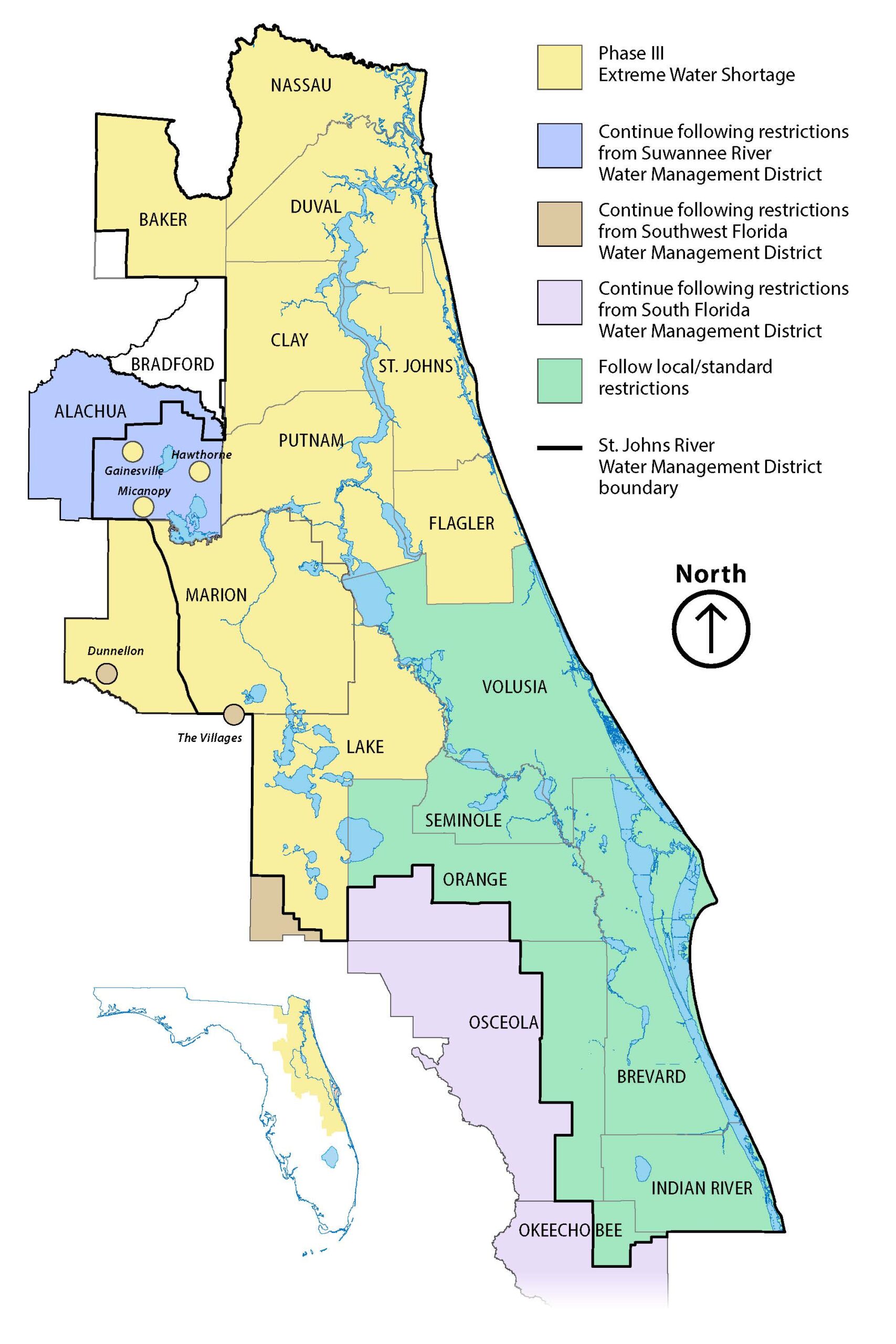
- Portions of Baker, Bradford, Lake, Clay, Duval, Flagler, Nassau, Putnam, and St. Johns counties within the District
- Portions of Alachua County within the District, excluding unincorporated areas overseen by the Suwannee River Water Management District
- Portions of Marion County within the District, the City of Ocala, and unincorporated areas of Marion County, excluding areas overseen by the Southwest Florida Water Management District
Under the Phase III declaration, residents are to follow the watering schedule below.
- Irrigation is never allowed between 8 a.m. and 6 p.m.
- Currently, irrigation is restricted to one day per week in accordance with the following schedule:
- Residential odd-numbered or no address: Saturday
- Residential even-numbered address: Sunday
- Nonresidential properties: Tuesday
Irrigation is limited to no more than three-quarters of an inch of water per zone and no more than one hour per zone on your scheduled day.
New plants/sod may be watered every day for the first 15 days after installation, up to three days per week for the next 30 days, and only two days per week for the final 15 days.
- Suspend cleaning and washing of golf carts, lawn mowers, and other equipment to the extent feasible.
- Reduce irrigation of fairways and driving range greens to no more than once per week. This excludes irrigating with a 100% reclaimed water source.
- Reduce irrigation of tees, golf course greens, and practice greens to no more than three times per week. This excludes irrigating with a 100% reclaimed water source.
- Eliminate irrigation of roughs to the extent practicable.
Outdoor water use, mainly lawn and landscape irrigation, can account for more than half of a typical household’s water use. Reducing lawn watering, especially during dry periods, is one of the most effective ways to lower overall demand on public water supplies, helps ensure water is available for essential needs, and can significantly reduce strain on water systems.
You can also save water by ensuring your irrigation system is working properly: test and repair broken pipes and leaks, fix damaged or tilted sprinkler heads, and check your irrigation timer to ensure settings are correct. Make sure your rain sensor or soil moisture sensor is working so your system does not run when nature has already provided sufficient water.
Outdoors
- Follow your local watering days and times and never water between 8 a.m. and 6 p.m.
- Inspect and repair leaks, broken pipes, and misaligned or clogged sprinkler heads in your irrigation system.
- Adjust your timer so your system runs only on your allowed day and for the minimum time needed.
- Make sure your rain or soil moisture sensor works.
- Use low-volume irrigation such as micro-irrigation, soaker hoses, or hand-watering for plants and shrubs instead of watering entire lawn areas.
- Delay installing new sod or other high-water use landscaping until conditions improve, if possible.
Indoors
- Fix leaking faucets, toilets, and showerheads.
- Install high-efficiency fixtures and appliances where possible.
- Run dishwashers and clothes washers with full loads only.
- Turn off the tap while brushing teeth or shaving.
State law requires the District to develop a Regional Water Supply Plan every five years that looks 20 years ahead at how much water people and businesses will need and where that water will come from. The plan outlines projected population and water demands, identifies both traditional and alternative water sources, and considers funding needed to develop those supplies. It provides a roadmap for future water decisions and shows how needs can be met through a mix of alternative water sources, traditional groundwater, and water conservation measures.
To protect water resources long-term, the District also:
- Conducts detailed hydrologic monitoring and modeling to understand how much water is available without harming springs, rivers, wetlands, and lakes.
- Sets minimum flows and levels (MFLs) to prevent significant harm from over-withdrawal.
- Issues consumptive use permits that limit how much water utilities, industries, agriculture, and others can withdraw and require conservation.
- Supports and co-funds alternative water supply and conservation projects with utilities, local governments, and other partners.
- Promotes public education on water conservation and Florida-friendly landscaping.
Yes. The District’s water shortage plan allows for additional phases with further restrictions if conditions continue to deteriorate. Staff continually monitor rainfall, groundwater levels, river flows, and water use to determine whether stricter measures are needed to protect water resources and public supplies.
For more information on water conservation and current watering rules, visit sjrwmd.com/wateringrestrictions or call 386‑329‑4500 to speak with one of our water conservation coordinators.
County specific restrictions
Alachua County water restrictions
Gainesville, Hawthorne, and Micanopy, which should follow the restrictions of the SJRWMD, while the remainder of Alachua County will remain under the Suwannee River Water Management District.
Marion County watering restrictions
All of Marion County, including the city of Ocala, is to follow the St. Johns restrictions. The only exceptions are The Villages and the city of Dunnellon, which should follow restrictions of the Southwest Florida Water Management District.
St. Johns County Utilities Customers in SilverLeaf
St. Johns County Utility customers will follow a new Reclaimed Water Conservation Schedule. Customers are assigned specific watering days and times based on subdivision and address. Details can be found here: SilverLeaf Reclaimed Water Schedule – St. Johns County
Orange County watering restrictions
All of Orange County is to follow the St. Johns restrictions. The only exception is Central Florida Tourism Oversight District, which will follow the South Florida Water Management District’s restrictions.
Nocatee watering restrictions
JEA’s Reclaimed Water Conservation Schedule, improves the reliability of the reclaimed water service. Nocatee is divided into four watering zones. Each zone has assigned watering days based on the number of irrigation days per week allowed by the SJRWMD, along with two days each week when reclaimed water service is unavailable. On those days, customers will still have access to outdoor potable water from their spigot. While your specific watering days may differ, this schedule follows SJRWMD guidelines for the number of irrigation days allowed each week. Under the current Phase III Extreme Water Shortage declared by the SJRWMD, landscape irrigation is limited to one day per week.
Irrigation Hotline Number: 386-329-4545